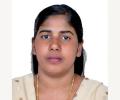
India continues to provide assistance to Nimisha Priya, an Indian nurse on death row in Yemen for the murder of a Yemeni citizen. The MEA is also in touch with friendly governments to find a solution. Reports claiming her death sentence has been revoked are incorrect.

The Supreme Court of India has dismissed a plea against the construction of a new passenger jetty and terminal at the Gateway of India in Mumbai, upholding a Bombay High Court verdict that allowed the project to proceed. The project aims to improve passenger travel between South Mumbai and other locations.
'Karur could still impact Jana Nayagan's box-office success if Vijay and the TVK do not get their act together,' points out N Sathiya Moorthy.

The Supreme Court of India has formed a Special Investigation Team (SIT) to investigate allegations of non-compliance with laws and irregularities at Vantara, a Green Zoological Rescue and Rehabilitation Centre in Gujarat. The SIT will examine the acquisition of animals, compliance with wildlife protection laws, and other related issues.

The National Sports Governance Bill has become an Act after President Droupadi Murmu gave her assent to the landmark legislation that promises to revamp India's sports administration.
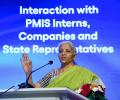
'As a result of delays, the desired reliefs are not coming for taxpayers.'

The Supreme Court has ordered authorities not to take coercive action against owners of diesel vehicles over 10 years old and petrol vehicles older than 15 years in Delhi-NCR.

The FIR, filed in December 2022 by M G Nagaraja, alleged that the 24-year-old Paris Olympian, along with his brother Chirag Sen, had fudged their age to get into playing age-group tournaments since 2010.
The Election Commission will publish the draft electoral rolls for Bihar assembly polls, triggering a period for claims and objections amid fears of voter exclusion.
The Supreme Court has granted interim protection to journalist Abhisar Sharma in an FIR lodged against him in Assam over a video post allegedly criticising the state's policies.

The Supreme Court has questioned the NHAI regarding toll collection on a highway stretch in Kerala where commuters face extreme delays. The court is reviewing a High Court order suspending toll collection due to poor road conditions and severe traffic congestion.
Glimpses from India and around the world that will make you smile and cry.
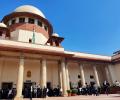
The Supreme Court addressed the issue of probe agencies summoning lawyers for providing legal advice to clients under investigation, emphasising that lawyers should not be summoned merely for offering legal advice but can be if they are assisting in the crime. The court is considering guidelines to prevent investigative overreach and protect lawyer-client privilege.
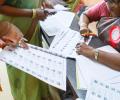
The Election Commission (EC) has published the draft electoral rolls for Bihar, marking a key step ahead of the upcoming assembly elections. The publication follows a month-long Special Intensive Revision (SIR) exercise.

The protesters shouted slogans such as KP Chor, Desh Chhod (K P Sharma Oli is a thief, quit the country), "Take action against corrupt leaders".

'Vigilance' is a dreaded term for PSB employees and there are instances where this fear is misused by the higher authorities to tame their subordinate officials. This fear always deters PSB executives from making decisions -- the fewer the decisions, the less the chance of falling into trouble, points out Tamal Bandyopadhyay.
The Supreme Court dismissed Allahabad High Court judge Yashwant Varma's plea seeking invalidation of a report that found him guilty of misconduct in the cash discovery row.

The Supreme Court has questioned the practice of Governors withholding assent to bills indefinitely, stating that it renders the constitutional provision of 'as soon as possible' meaningless.
A two-judge bench of the top court in 1981 questioned the correctness of the 1967 verdict holding Aligarh Muslim University not to be a minority institution since it was created by a central law and referred the issue to a larger bench for decision.
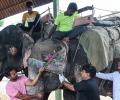
Thousands of people participated in a 'silent march' in Kolhapur on Sunday, demanding that 36-year-old female elephant Mahadevi (also called Madhuri), be brought back from Vantara wildlife rescue, treatment, and rehabilitation centre in Gujarat's Jamnagar district.

The Bombay High Court has directed the city civic body to invite objections before allowing controlled pigeon feeding at Dadar Kabutarkhana.

The Supreme Court has stated it will intervene if there is mass exclusion in the special intensive revision of electoral rolls in Bihar, emphasizing the Election Commission's role as a constitutional authority.

Patel emphasised that one of the most important features of the bill is the establishment of a dedicated tribunal for resolving disputes, reducing the burden on the judiciary and ensuring quicker justice.
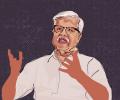
'The quality of justice is directly linked to the quality of judges -- if that suffers, justice delivery suffers.'

CJI Gavai said that as head of the Judicial Infrastructure Committee he had prepared a model of setting up new taluka and district-level courts
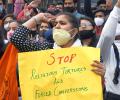
The Supreme Court has sought the Uttar Pradesh government's response on a plea challenging certain provisions of the 2024 amended UP law on unlawful religious conversion, citing concerns about free speech and religious propagation.
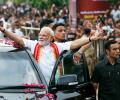
'Non-BJP state governments and their leaders, navigating today's political landscape, know well they have no clue what awaits around the corner.' 'The chances of charges pressed and oneself getting parked in custody play out on an uneven playing field,' points out Shyam G Menon.
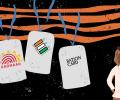
When the government chooses to either ignore or use identity documents only when it suits them, it shakes people's sense of stability, notes Shyam G Menon.
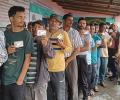
The Election Commission has assured the Supreme Court that no voter's name will be deleted from the draft electoral roll in Bihar without prior notice and a fair hearing. The EC also clarified that it is not required to share separate lists of those not included in the draft rolls.

The Supreme Court has ordered the removal of all stray dogs from Delhi-NCR streets following concerns about rabies and dog bite incidents, particularly those involving children. The court criticized animal lovers and activists, questioning their ability to compensate for the loss of life due to rabies.
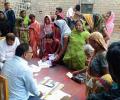
The Election Commission of India is preparing for a nationwide special intensive revision (SIR) of electoral rolls, following a Supreme Court ruling. This move aims to update voter lists and address concerns about illegal migrants.

The Supreme Court has directed the Centre to explore providing insurance covers to defence cadets who suffer injuries or disabilities during training, emphasizing the need to support these 'braveheart cadets'.
Last-minute efforts are underway to halt the scheduled execution of an Indian nurse in Yemen, with a Sufi scholar leading negotiations with the victim's family.

The Supreme Court of India has censured BJP MP Nishikant Dubey for his remarks against the judiciary, stating that his comments "tend to scandalize and lower the authority of the Supreme Court of India." The court dismissed a contempt petition against Dubey but issued a scathing order criticizing his remarks, which included accusations that the court was "taking the country towards anarchy" and that Chief Justice Sanjiv Khanna was "responsible for the civil wars taking place in the country." The court deemed Dubey's statements "highly irresponsible" and indicative of an attempt to "incite religious wars." The order highlighted the importance of maintaining public confidence in the judiciary and condemned attempts to undermine its authority.

The Juvenile Justice Board on Tuesday said the 17-year-old boy accused of driving a Porsche car in an inebriated state and mowing down two persons last year in Pune will be tried as a juvenile.
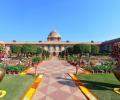
The Supreme Court has ruled that a Governor cannot send bills to the President for consideration if the state assembly has already cleared them for a second time. The court was questioning the Centre over the powers of the Governor when it comes to granting assent to bills.
The top court said an accused has a right to voluntarily undergo a narco-analysis test at an appropriate stage.

The bench said, given the pressing nature of the crisis, particularly in cities like Kota, Jaipur, Sikar, Vishakhapatnam, Hyderabad, and Delhi, where students migrate in large numbers, immediate interim safeguards are the call of the day.
'Earlier, we used to talk about a deficit economy. There is a deficit in democracy' 'If you read superficially Gandhi and Ambedkar and Nehru, some misconceptions and misunderstanding come to mind, as if they were at loggerheads and they differed radically in their views' 'India is one nation. There is only one citizenship. No citizenship for South India and no citizenship for North India and another for the Northeast'
'This type of comprehensive legislation has never been introduced before in Parliament's history.' 'A bill that simultaneously affects ministers, chief ministers, and the prime minister represents completely uncharted Constitutional territory.' 'Throughout our nation's legislative history, the established policy has consistently held that public office holders should face punishment only after receiving conviction from a competent court of law. Without this safeguard, we risk systematic destabilisation, and our federal structure would face complete collapse.' 'Any central government could potentially deploy this legislation against state governments they oppose politically. This represents the most frightening prospect and dangerous possibility that these bills create.'
 © 2026 Rediff.com - Advertise with us - Disclaimer - Privacy Policy - Sitemap - Feedback - About us - Terms of use - Grievances